| Planning decision | Supported detail | Planning use |
|---|---|---|
| Script length | A 90-120 page document in Courier 12pt on 8.5 x 11 inch paper | Shape the story to fit this range before you start drafting. |
| Screen time | One formatted Courier page equals roughly one minute of screen time | Use page count as a quick check on runtime and pacing. |
| Genre length | Comedies run about 90 pages (1.5 hours); dramas about 120 pages (2 hours) | Aim shorter for comedy and longer for drama. |
| Font | Courier, 12 points, an entertainment industry standard | Set it once in your software before you write a scene. |
| Script type | A spec script should never contain shooting-script elements such as camera shots and transitions | Describe what happens on screen and leave the directing to others. |
These figures come from The Writer’s Store screenwriting guide and Final Draft’s formatting guide.
Writing a screenplay works best as a sequence: test the concept, outline the story, give characters goals, draft in standard format, then revise. The key condition is a solid outline, because a weak one means several rewrites.
Once the script is finished, the natural next question is how is an independent film made, and the Film & TV Production Basics hub picks up from there. If you are still hunting for a story to practise on, Short Film Ideas For Students: 30 Quick, Low-Budget Concepts To Shoot This Semester (2026) offers small-scale concepts. If you are unsure what the finished document actually is, What Is a Screenplay? The Essential Guide for Writers and Movie Fans (2026) covers that.
The roadmap from idea to revised draft
The answer to how to write a screenplay is to do the cheap thinking first and the expensive writing second. Each step below protects the next one, so skipping ahead usually costs time later.
- Test the concept. Script Reader Pro notes that tweaking the concept or story before drafting can save months of rewrites, so get a reader’s reaction to your idea first.
- Write a logline. A logline is a sentence or two that sums up the core conflict of your story. If you cannot state the conflict that briefly, the story is not ready to outline.
- Sketch the story in prose. Write a beginning, a middle and an end as plain paragraphs. These benchmarks become the basic three-act structure.
- Give each main character a goal. The same guide calls characters without a goal the number one downfall of spec scripts.
- Build the outline. Break the prose story into the scenes that make up each act, in as much detail as you can manage.
- Set up the format. Choose Courier and the correct margins before page one, so you never reformat a finished draft.
- Draft the scenes. Show what is happening instead of telling it, and write dialogue the way people actually talk.
- Revise and check the format. Fix story problems first, then confirm that every element on the page follows screenplay conventions.
Story structure and the outline
Structure is the part of writing a screenplay that determines how many rewrites you face. Settle it on paper, where changes are cheap.
From logline to three acts
Start with the logline, then expand it into prose beats. According to Script Reader Pro, the beginning, middle and end of that prose version become your basic three-act structure. This route suits writers who find act diagrams abstract, because the acts emerge from a story you have already told in plain language.

Outlining scene by scene
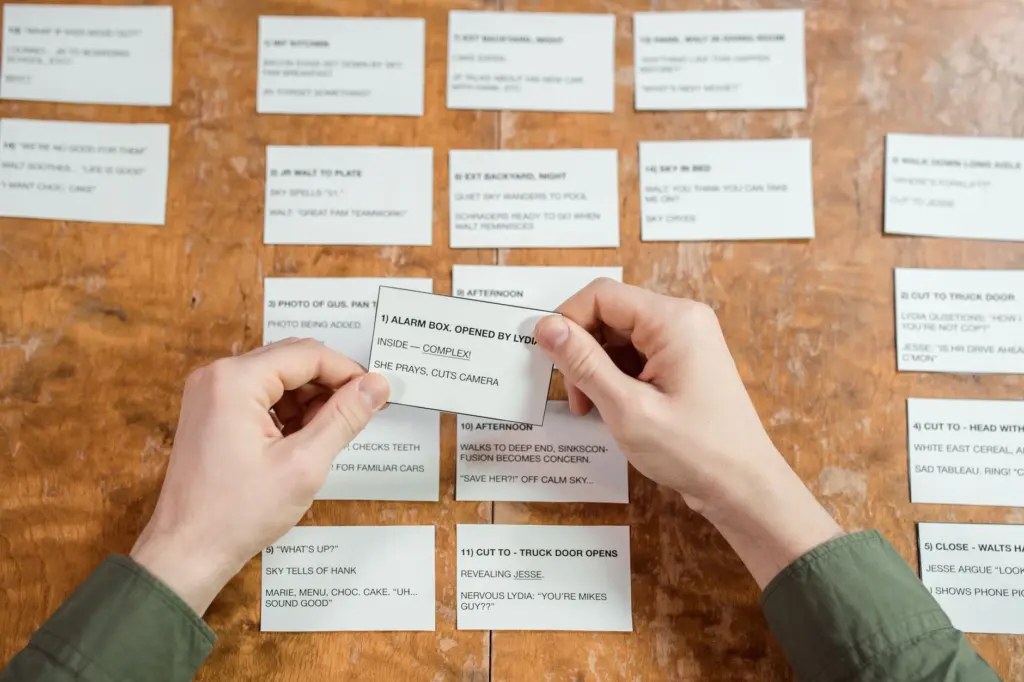
The outline takes that prose story and breaks it into the scenes that make up each act. The most important instruction in the same guide is to be as detailed as you can, though the technique itself varies by writer. Index cards, a document or a corkboard all work, so choose whichever lets you move scenes around easily.
The effort pays off in the draft. A lacking outline, the guide warns, can mean several rounds of rewrites, so a thin outline is not a time saving.
Characters, dialogue and subtext
Character comes before dialogue, because a line only sounds right once you know what the speaker wants.
Goals drive the scenes
Give every main character a clear goal before you outline. Missing goals are a common reason spec scripts fail, so check each scene against what the protagonist is trying to get. A scene with no one pursuing anything is a candidate for cutting or rewriting.
Natural dialogue
Write dialogue the way people actually talk. Script Reader Pro puts it simply: less is almost always more. Cut any line that exists only to explain, and read exchanges aloud to catch lines no one would say.
Subtext and showing
Subtext lives in the gap between what a character says and what the screen shows. The Writer’s Store advises that a screenwriter must show what is happening rather than tell it, and that pivotal moments can be conveyed through something as simple as a look on an actor’s face. Use that when a character hides a feeling: write the look or the action, not a line announcing the emotion.
Formatting that readers expect
Format is a decision about being read, not decoration. These conventions are the ones the supplied guides agree on.
- Margins. StudioBinder sets the top, bottom and right margins at one inch and the left margin at one and one-half inches.
- Seven line types. The same guide lists scene heading, action, character, parenthetical, dialogue, shot and transition. A spec draft will mostly use the first five.
- Character cue and dialogue block. The character name sits above the dialogue it introduces. The Writer’s Store gives the dialogue indent as 1.0 inch on the left and 1.5 inch on the right, with a width of 3.5 inch.
- Transitions. These are film editing instructions and generally appear only in a shooting script, so leave them out of a first spec draft.
Screenwriting software normally handles these settings. If you write in a word processor instead, set the margins and styles once and reuse them for every scene.
Revising the draft
Revision is where the outline either pays off or exposes itself. When a scene feels wrong, look back at the outline before polishing sentences, since a lacking outline is what leads to several rounds of rewrites.
Feedback is most useful when it targets the story. Ask a reader to react to the concept, the goals and the scene order before you spend time on line-level tweaks. Early feedback is the cheapest rewrite you will ever do.
- Wait for notes if you are still unsure what the protagonist wants. Fixing the goal later will change nearly every scene.
- Move to a format check if the story reads clearly to someone else. Scan each page for the line types above and for any shooting-script elements that crept in.
- Go back to the outline if a reader loses track of cause and effect. Rework the scene order there rather than patching pages.
Frequently asked questions
What does a scene heading contain?
A scene heading has three elements: INT. or EXT., the location, and the time of day.
When should I use a parenthetical?
Rarely. Today parentheticals are used only if absolutely necessary, so let the dialogue and action carry the delivery.
What goes on the first page?
The first page is the Title Page, which shows the title and the writer’s name.
Does formatting really matter?
Yes. StudioBinder warns that improper formatting can kill the chances of a screenplay ever getting made, so treat it as part of the writing.