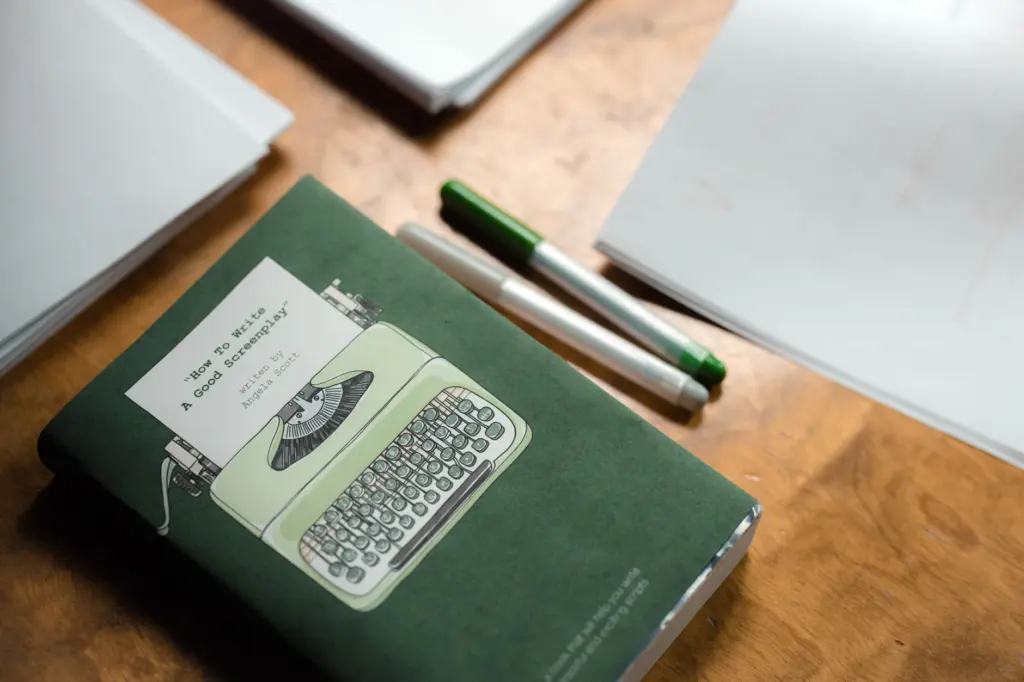
Someone hands you a stack of pages and asks whats a screenplay. It is a story written for the screen in a precise format, with scenes, action and dialogue laid out so a production team can read it.
Readers who want the wider process can start with how is an independent film made, then return here for the detail of the page itself.
What a screenplay is, and what it is not
A screenplay is the written form of a screen story. StudioBinder defines script writing as the process of writing stories for film, TV, video games and commercials, and its definition covers formatting as well as storytelling. A screenplay is therefore two things at once: a narrative and a layout. The most common mistakes come from treating it as only one of them.
The table below sets the usual assumptions against what is supported.
| Common assumption | What is supported | What it means for you |
|---|---|---|
| A screenplay is a story with dialogue added | Script writing includes formatting as well as storytelling | Treat layout as part of the craft, not a polish step at the end |
| It should read like a novel | Writing scripts requires a visual mindset and precise formatting that most other forms of writing do not demand | Describe what an audience can see and hear instead of explaining thoughts |
| Formatting is cosmetic | Proper script formatting ensures that pacing and timing translate effectively to the final production | Standard layout lets a reader judge rhythm and scale from the page |
| A screenplay is only for cinema | Script writing serves film, TV, video games and commercials | The discipline of visual, formatted writing carries across screen media |
The definitions and contrast points above come from StudioBinder’s guide to script writing.
The practical lesson is that a screenplay is a working document for other people. Whoever opens it needs to find where each scene happens, what is visible in it and who is speaking, and the parts below are how a script delivers that information.
The parts of a screenplay
A screenplay is built from a small set of repeating elements: sluglines, action lines, character names and dialogue, arranged inside a larger act structure. Learning to spot each element is also the fastest way for a film fan to start reading scripts.
Sluglines
A slugline, also called a scene heading, tells the reader where the action is happening. Toronto Film School notes that it shows whether the scene takes place inside (INT.) or outside (EXT.), together with the location and the time of day. A heading such as INT. KITCHEN – DAY packs all three into a single line. Every new location or time change calls for a new slugline, which makes the heading the script’s basic navigation tool.
Action lines
Action lines tell the reader what the actors are doing and describe what is unfolding visually, as StudioBinder explains in its script writing overview. They sit between the slugline and the dialogue. A good rule of thumb follows from the visual mindset described above: put on the page only what a camera or microphone could capture. A character’s private thoughts need an action, a look or a line of speech before an audience can receive them.

Character names and dialogue
Dialogue is what characters say, introduced by the speaker’s name. Toronto Film School’s advice is to keep dialogue concise and conversational and to consider how each line ties back to the central conflict. It also recommends using nuance and subtext to reveal a character’s emotions and motivations while avoiding exposition. In practice, a line in which characters explain things they both already know is the usual warning sign.
Dialogue is a craft in its own right. The Australian Film, Television and Radio School’s library guide lists screenwriting books that cover how to apply dialogue in scripts for dramatic effect.
Three-act structure
Most scripts, according to Toronto Film School, follow a three-act structure: Act One is the set-up, Act Two is the confrontation and Act Three is the resolution. No Film School describes Act One as the foundation on which the rest of the story is built. For a viewer, this means the opening stretch of a film is doing structural work: introducing the people, the setting and the central conflict that the rest of the script will test.
Formatting rules that carry the story
Screenplay formatting is a set of fixed conventions that make every script look and behave alike. Toronto Film School’s script writing guide gives the practical basics:

- Font and size: pick a standard font, such as Arial or Typewriter, set at 12-point.
- Margins: keep 1-inch margins on all sides of the page.
- Dialogue layout: write all dialogue in standardized centred columns.
- Character names: put names in all caps so a speaker is easy to spot as the eye moves down the page.
- Scene headings: begin each scene with a slugline giving INT. or EXT., the location and the time of day.
These rules matter because consistency lets readers concentrate on the story instead of decoding the layout. Because proper formatting also helps pacing and timing survive the move into production, a script that departs from the conventions can mislead the people who rely on it to judge length and rhythm.
For a page-by-page look at these conventions applied, Screenplay Format Example: A Simple, Ready-To-Use Guide For Writers (2026) shows the layout in a usable form.
Who writes and reads a screenplay
A screenplay is a shared reference point for the screenwriter, the producer and the director. Each of them approaches the same pages from a different direction.
For the screenwriter, Toronto Film School describes the work as a combination of creativity, structure and personal drive, and adds that breaking into the film and television industry as a writer demands perseverance. That is a useful expectation to hold: the format is learnable, but the career side takes sustained effort.
For the director, the script is where the job begins. The AFTRS library guide describes David Mamet’s 1991 directing book as looking at every aspect of directing, from script to cutting room. A film fan can take the same idea from that description: the page is the earliest version of the finished film, and later decisions are made against it.
If you are ready to move from reading to drafting, How To Write A Screenplay: A Clear 8-Step Roadmap For 2026 turns these elements into a step-by-step process.
Frequently asked questions
| Question | Answer |
|---|---|
| Do I need to be hired before I write a screenplay? | No. StudioBinder notes that script writing can be done for hire or on speculation, with speculative writers hoping to sell the screenplay or find an agent. |
| What is the inciting incident? | No Film School defines it as the event that disrupts the protagonist’s ordinary life and sets the main conflict in motion. It belongs to the foundation-building work of Act One. |
| What should the opening scene do? | It is the chance to captivate the audience from the start. According to No Film School, it sets the tone, introduces characters and establishes the story world. |
| Which book is a good starting point for learning the craft? | The AFTRS library guide calls Syd Field the forefather of the screenwriting how-to, and lists his updated 2005 edition of the classic guide. |