| Setting | Supported value | Planning use |
|---|---|---|
| Typeface | Fixed-pitch Courier 12 pt | Set the font once in your template and leave it alone, because page counts depend on it. |
| Margins | 1 inch (25.4 mm) on all sides, US Letter | Check the page size before you export, since a different paper size changes where lines break. |
| Alignment | Left-aligned, not justified | Turn off any justify option so line endings stay ragged on the right. |
| Timing | About one page per screen minute | Use it as a rough running-time guide for a feature, not as a stopwatch. |
These figures come from Alan Watt’s script format guide and a screenplay formatting template.
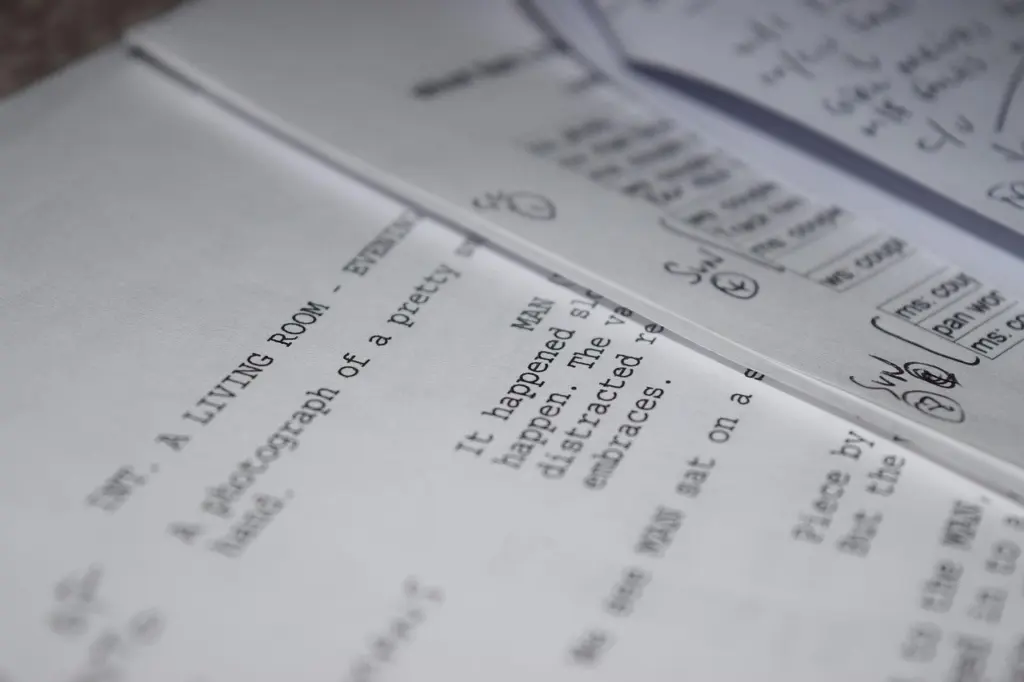
A screenplay format example comes down to Courier 12 pt type, 1-inch margins and a fixed order of sluglines, action lines, character cues and dialogue, which together keep one page close to one minute of screen time.
Formatting is one small part of the process. The overview of how is an independent film made shows where the script fits, and the rest of this page works through the page rules and a marked-up scene.
Page length and running time
A formatted script page works as a timing tool, which is why the rules are so rigid. A formatting template for screenwriters explains that most of the rules exist because of timing, to preserve the page-per-minute screen time estimate. Feature screenplay format follows a one-page-per-minute standard, according to Alan Watt’s guide.
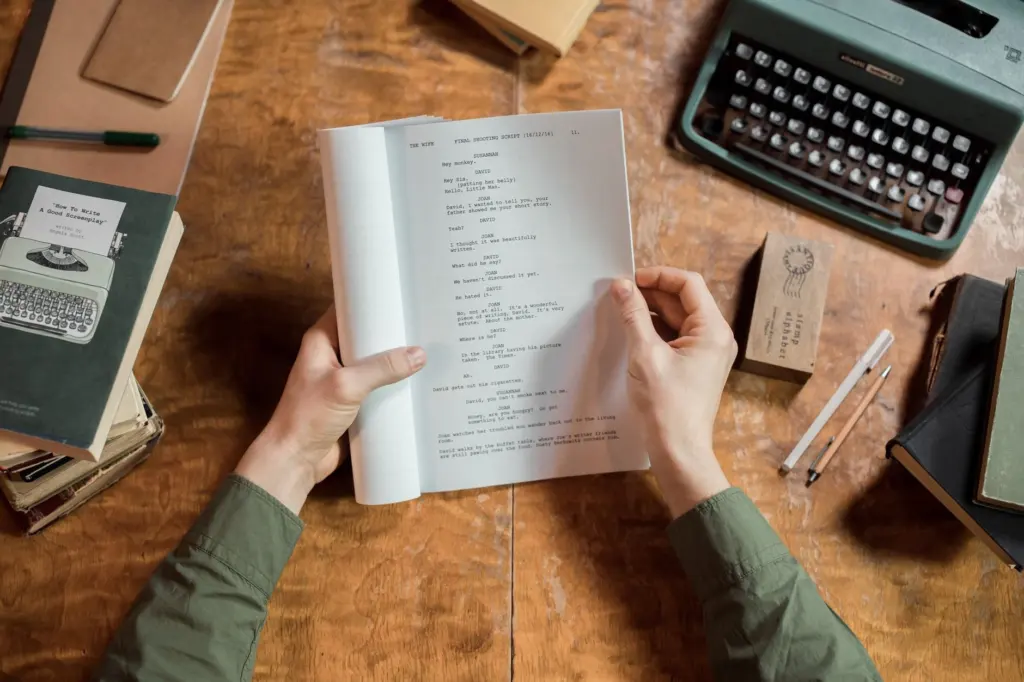
For a screenwriter, the practical result is that page count becomes a way to judge how long a story will run before anyone shoots a frame. A scene that fills a page and a half is expected to take roughly that much screen time. Producers, readers and collaborators can size up a script quickly because every writer is working to the same page conventions.
The rule does not apply evenly to every form. Alan Watt notes that sitcoms usually end up at about 30-45 seconds of screen time per page. A television comedy writer should therefore not carry feature expectations across, because a page of sitcom script covers less screen time than a feature page. Check the standard for the specific form before you judge the length of a draft.
Because the estimate is only as reliable as the page layout behind it, the next question is what the layout itself should look like.
Font, margins and alignment
The standard screenplay typeface is Courier at 12 pt. The template guidance asks writers to use only fixed-pitch Courier 12, the standard font for screenplays. A fixed-pitch face gives every character the same width, so a page of script holds a predictable amount of text. That predictability is what keeps the page-per-minute estimate meaningful.
Margins are one inch (25.4 mm) all around on US Letter paper, as the same template specifies. The guidance is also direct about alignment: do not justify the margins. Text stays left-aligned with a ragged right edge, which matches the plain look of a typed script.
Three decisions follow from these specifications:
- Start from a template. A script template with the font, page size and margins already set removes the most common sources of drift. It suits anyone who is formatting by hand in a general word processor.
- Do not shrink margins to save pages. Tightening them changes how much text each page holds, so the page count would no longer match the screen time it is meant to predict.
- Leave the right edge ragged. Justified text stretches word spacing and departs from the plain typed look readers expect.
With the page set up, the elements can be placed on it. The scene below shows how.
A formatted scene, line by line
The sample scene uses the four core elements: a slugline, action lines, character cues and dialogue. The scene is original to this page and written only to show the structure.
INT. LAUNDROMAT – NIGHT
Rain streaks the front window. A single dryer turns. MAYA, in a damp coat, sits on a folding table and watches it spin.
The door bangs open. JONAH hauls in a duffel bag and stops when he sees her.
MAYA
You’re late.
JONAH
The bus broke down.
MAYA
Again?
Jonah drops the bag beside the dryer. Maya finally looks at him.
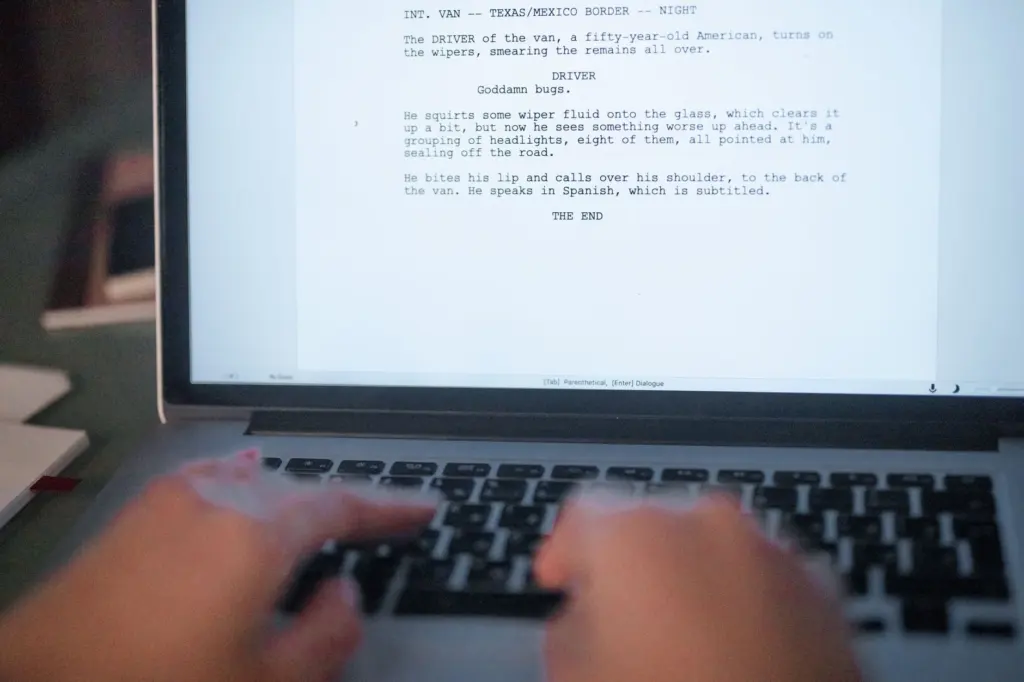
On a real script page each element has its own horizontal position. The slugline and action run from the left margin, while the cue and dialogue sit in toward the middle of the page. Screenwriting software or a template handles that placement. The notes below explain what each part is doing.
Slugline
The first line is the slugline, also called a scene heading. It tells the reader where and when the scene happens. Alan Watt’s guide says scene headings indicate interior (INT.) or exterior (EXT.), the location and the time of day. The formatting template gives the pattern as EXT. SET/LOCATION, DESCRIPTION – DAY. The sample swaps in INT. and NIGHT, but the order is the same: interior or exterior, then the place, then the time. A new slugline marks a new scene, so write one whenever the location or time changes.
Action lines
The paragraphs under the slugline are action lines. They carry what the camera and audience can see and hear. A screenplay does not need the detail a novel would carry, since a lot of information that would appear in a novel can be omitted. In the sample, the rain, the dryer and the dropped bag are all visible. Maya’s mood is not stated; the reader infers it from her refusal to look up.
Guidance for multi-camera television asks for action lines written in present tense, left aligned and limited to concrete, observable details. The sample follows the same habit, and it keeps each paragraph short so the eye moves quickly down the page.
Character cue and dialogue
Each speech starts with a character cue, the name of the speaker placed directly above the words. The dialogue follows underneath. In feature film screenplays dialogue is single-spaced, as Alan Watt points out. The same guide describes screenplay dialogue as indented, in contrast with stage plays. One screenplay examples guide describes it as centered in the middle of the page. In practice, let the template position the block rather than eyeballing it.
In the sample, Maya and Jonah each speak in short lines, and the action beat between them replaces any stage direction inside the speech. When the story needs a pause or a gesture, put it in an action line and keep the dialogue itself to the words spoken.
Why the conventions exist
The format is a working tool for the people who make the film, not decoration. The Kinolime guide says many of the conventions and guidelines for scriptwriting arose to benefit the ease of film production. Alan Watt makes the same point from the writer’s side: the format ensures clarity, collaboration and production readiness. A reader who opens a correctly formatted script knows immediately where each scene is set and who is speaking. A script that departs from the layout makes that harder, and it gives readers a reason to doubt that the writer understands the form.
The best way to absorb the layout is to read real pages. No Film School’s collection of screenplay examples presents produced scripts as a way to see how professionals format and collect their ideas. The Kinolime guide also points to a screenplay sample from Top Gun: Maverick among its genre examples. Put a produced script beside your own and compare how each element is positioned and how much text each action paragraph carries.
- Still defining the term? Read What Is a Screenplay? The Essential Guide for Writers and Movie Fans (2026) for the basics before you worry about layout.
- Curious about the screen-side crafts? Videography vs Cinematography: A Clear Guide To Their Differences And Which To Choose In 2026 covers how camera work is described and divided.
- Ready to write? Open a template with the font, margins and page size already set, and start with the slugline.
Frequently asked questions
Do stage plays use the same margins as screenplays?
No. Alan Watt’s guide gives stage play scripts 12 pt Courier with 1-inch margins, but with 1.5 inches on the left for binding. Screenplay margins are one inch all around.
Can I write a whole action line in capitals for emphasis?
No. In screenplays only specific words are put in all caps to highlight key aspects, according to Alan Watt’s guide. Reserve capitals for the few words that matter.
Should numbers in dialogue be written as digits?
No. The formatting template says to spell out numbers in dialogue and to avoid symbols and abbreviations, so that the actor sees exactly the words to be spoken.