| Milestone | What happened | Planning use |
|---|---|---|
| 1901 | The bi-pack process, founded by Adolf A. Gurtner, is described as the first significant innovation in chroma key technology. | Cite it as the earliest named milestone in the technique’s history, not as green screen itself. |
| 1912 | The Williams process integrated actors with previously shot backgrounds using a moving matte. | Shows the goal that still drives keying: placing a performer into a separately captured background. |
| 1927 | The Dunning process used a blue background with yellow foreground lights. | An early example of blue as the background colour, useful context when a crew asks why blue screens exist. |
| 1940 | The Thief of Baghdad is credited as the first film to use blue screen technology with chroma keys, and it won an Academy Award for Special Effects. | A reference film for the blue-screen era rather than a model for today’s workflow. |
| 1960s to 1980s | The yellow-screen (sodium vapour) process was popular until computer software took over. | Explains why software, not film chemistry, now shapes keying decisions. |
Milestones are drawn from SCAD RenderQ’s short history of green screen and Under the Moonlight’s chroma keying walkthrough.
When was green screen invented? There is no single date: chroma key has been evolving since at least the 1900s, early film milestones used blue, and green became the software-era default.
If you are planning a shoot rather than tracing history, add keying decisions to your video production checklist so colour, wardrobe and lighting are settled before the camera rolls.
What the history means for your next shoot
Because chroma key grew out of matte and blue-screen practice, the modern decision is less about dates and more about colour, light and wardrobe. These choices follow from the timeline:

- Default to green. Unless a scene or costume argues otherwise, green is the lower-friction starting point, and the reasons are set out in the mechanism section below.
- Choose blue for specific problems. Night scenes or green wardrobe are the supported cases where a blue screen suits better, and blue screens remain in use in some instances.
- Audit wardrobe and props. Anything that matches the key colour disappears when the key is pulled in post-production, so a garment or prop in the key colour will vanish along with the background.
- Plan coverage around the keyed shot. Cutaway footage gives an editor alternatives around a composite, and B-Roll Explained: What It Is, Why It Matters, And How To Use It In 2026 covers how to plan it.
- Skip the screen when the location is the backdrop. At live events, such as the coverage laid out in The Ultimate Wedding Shot List: Must-Have Photos And A Simple Timeline For Stress-Free Coverage (2026), the real venue is the background, so there is nothing to key and the effort goes into shot planning.
Knowing where each practice came from makes these choices easier to defend, so the timeline comes next.
From matte paintings to digital keying
Matte paintings and multiple exposures
Chroma keying moved from multiple exposures to traveling mattes over decades. Matte painting is the painted-background branch of that family. Mary Poppins (1964) won an Oscar for special effects by mixing live-action people, animation and matte-painted backgrounds. That makes it a useful reminder that a convincing composite has often combined several methods rather than relying on one.
The bi-pack process, founded by Adolf A. Gurtner in 1901, is the earliest milestone in this timeline. It belongs to the pre-green history of the effect, long before a keyer existed.
Traveling mattes and the blue-screen era
A traveling matte separates a moving subject from its background so the two can be recombined. Early versions progressed from black to blue mattes and used the film development process to do the separating. The Williams process of 1912 integrated actors with previously shot backgrounds, and The Invisible Man (1933) used the Williams method to make its lead actor disappear. The Williams process stayed effective until the Dunning process arrived in 1927, which relied on a blue background lit with yellow foreground lights (SCAD RenderQ).
RKO Studios developed a hidden sequence imager in the 1930s, followed by a bluescreen method. By 1940, The Thief of Baghdad was described as the first film to use blue screen technology with chroma keys. Histories differ on which method deserves the “first” label, so treat that title as a convenient landmark rather than a settled verdict.
Yellow screen, LED blue and the software takeover
The yellow-screen process was popular from the 1960s to the 1980s until computer software took over. Blue stayed in play alongside it: The Empire Strikes Back (1980) used an LED blue screen that separated a narrow slice of blue light (SCAD RenderQ), and The Jungle Book (2013) was filmed entirely in a blue screen studio indoors.
Blue never disappeared from this record, which is why the useful question for a modern shoot is which colour suits the software, the light and the wardrobe. The next section answers that.
Why green overtook blue in everyday keying
Green is the usual choice today for four reasons that reinforce one another, according to CrumplePop’s explainer.
- Distance from skin tones. Green is the colour furthest from human skin tones, so it is the easiest to key out without removing part of a person.
- Camera sensors. Digital cameras use a Bayer pattern with twice as many green cells as blue and red, which makes them more sensitive to green.
- Software defaults. Most chroma-keying and post-production software is set up for green by default, which speeds the workflow.
- Lighting demand. Blue screens require more light to expose properly than green, so blue costs more lighting effort even when it is the right colour for the scene.
For most productions that adds up to a clear recommendation: use green and move to blue only when the scene or costume forces the issue. With the colour chosen, the remaining work is making the key clean.
How chroma key works on set and in post
Pulling the key
A green screen is the coloured background you want to make transparent and remove from your shot, and chroma key is the technique used to remove it. Software samples the key colour and makes everything that matches it transparent, so the replacement background shows through. Modern keying software gives much more control over the range of colours keyed and over how the key is applied than the film-printing methods that came before it. That control is the practical gain of the software era: edges and tolerances can be adjusted after the shoot instead of being fixed in the lab.
Preventing spill and shadows
Color spill is the coloured light that reflects onto the subject from the screen, and it makes edges look green after the key. Keeping the subject at least six feet (about 1.8 m) from the screen helps avoid multiple shades of green and reduces spill. The screen itself should be completely flat, because creases or wrinkles form shadows that give the keyer several shades of the key colour to deal with.
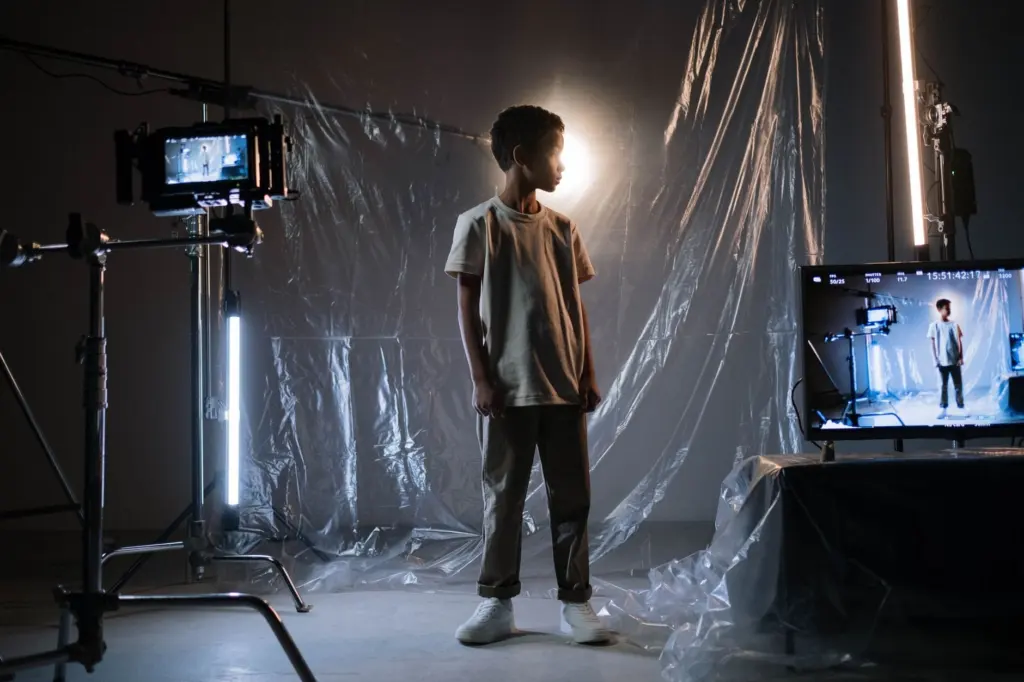
Treat distance and flatness as the two cheapest fixes. Both are decided on set, and neither can be fully recovered once the key is pulled in post.
Frequently asked questions
Who is credited with the sodium vapour process?
Petro Vlahos is cited as the inventor of the sodium vapour (yellow-screen) process and of a refined blue screen system. He died in 2013 at the age of 96.
Which keyer do professionals commonly use?
Ultimatte is a commonly used keyer for professional work, with plug-ins that can work in most applications.
What kind of fabric suits a mounted screen?
Foam-backed fabric is recommended for mounted screens because it scatters light evenly, which avoids luminous hotspots.
Did other classic films use blue screen after The Thief of Baghdad?
Yes. The African Queen (1951) used blue screen to depict some of the film’s more harrowing moments.