Unique art styles offer clear ways to refresh a studio practice and a portfolio. This article lists five unique art styles that artists can try in 2026. Each style shows a different toolset, material focus, and audience. The reader will see practical starting points and brief examples. The text stays direct and short to help quick decisions.
Key Takeaways
- Unique art styles offer artists ways to revitalize their portfolios and studio practices with diverse tools and audiences.
- Vaporwave and retrofuturism blend nostalgic and futuristic visuals using pastel gradients and classic motifs, ideal for digital collages and prints.
- Glitch art embraces errors in digital files to create intriguing textures and conversations about control and chance in art making.
- Neo-Fauvism emphasizes bold, saturated colors and simplified forms, focusing on emotional clarity through color-forward painting.
- Generative and AI-driven art merges coding and human creativity, producing pieces that highlight collaboration between artist and machine.
- Textile, embroidery, and fiber arts transform traditional craft into fine art, valued for their tactile quality and storytelling potential.
Vaporwave And Retrofuturism: Nostalgia Reimagined
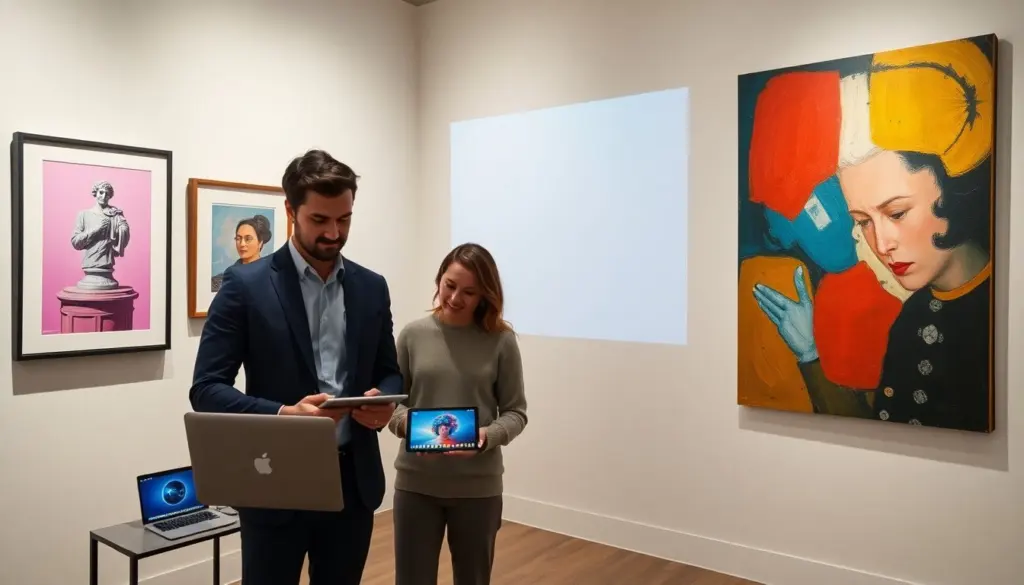
Vaporwave and retrofuturism draw on past media and future ideas to create a striking look. Artists use pastel gradients, VHS grain, and 3D objects to build scenes. The movement often combines classical sculpture imagery with neon color and old tech motifs. A practitioner starts with found digital assets and mixes them in simple collage software. They adjust color curves and add scanline textures to enforce mood. Collectors respond to the deliberate anachronism. Curators place these pieces in digital shows and print editions. Students can replicate the style with free tools and a modest monitor calibration. The style often appears in album art, motion loops, and limited prints.
To get beyond surface aesthetics, consider focusing a series on a consistent narrative or motif—an object, a memory, or a fictional brand identity—so disparate images resolve into a cohesive body of work. Practical starting steps: assemble a moodboard of period visuals, digitize found ephemera, experiment with 3D mockups and looping GIFs, and test print proofs to confirm color shifts. Pay attention to licensing for found assets and to display choices: backlit prints, LED screens, and short video loops reinforce the nostalgic-technical tension that defines the style.
Glitch Art And Data Aesthetics: Beauty In Brokenness
Glitch art treats error as a compositional element. Artists corrupt files, misread code, or misalign pixels to produce unexpected forms. They export a working image, alter the file bytes, and reopen it to see new artifacts. Photographers use deliberate overexposure or sensor noise to match the effect. Installations pair noisy projections with sparse sound to emphasize texture. Galleries show these works to an audience that values process visibility. A designer can use simple scripts to generate variations and then select strong frames. The practice invites experimentation and quick iteration. It also creates a clear dialogue about systems, control, and chance in image making.
When experimenting, keep a log of methods and parameters so you can recreate or iterate on successful glitches—this becomes part of the artwork’s provenance. Try both analog and digital tactics: feed images through faulty hardware, rescan prints, open files in a hex editor, or pipe image data through creative-coding sketches. Consider presentation: projected loops, large-format prints that foreground artifacts, and multiscreen installations each highlight different qualities. Ethically, be transparent about whether glitches are accidental, simulated, or algorithmically generated, as that transparency strengthens critical conversations with curators and collectors.
Neo‑Fauvism And Color-Forward Painting Today
Neo‑Fauvism pushes color to the foreground and reduces detail to gesture. Painters choose saturated palettes and bold brushwork. They block color into large planes and let edges remain raw. The style favors direct painting on canvas and quick drying media like acrylic. Critics praise the vividness and the focus on emotional clarity. Students start with color studies and limit the palette to three or four intense hues. A gallery may pair a Neo‑Fauvist canvas with a neutral ductile wall to let the color dominate. The approach suits portraiture, landscape, and abstract work. Artists often sell small series that share a color logic.
To develop a distinctive voice within Neo‑Fauvism, define a consistent approach to palette, mark-making, or scale. Practice systematic color experiments—large swatches, glazing tests, and painted studies—to learn how hues interact under different lighting. Consider materials beyond acrylic: alkyds, oils with fast-drying additives, or mixed-media surfaces can sustain saturation while adding texture. When exhibiting, use lighting that preserves chroma and avoid overly warm or cool bulbs that shift perception; photographs for portfolio use should include a color reference to ensure accurate reproduction.
Generative And AI-Driven Art: Rules, Randomness, And Collaboration
Generative and AI-driven art uses code and models to produce new imagery. Artists set rules and then let systems run to create many variants. They curate outputs and refine prompts or parameters to reach a final piece. Some practitioners combine hand-work with generated base layers. Museums buy pieces that show the authoring method clearly. Developers and artists pair to keep technical control while preserving aesthetic intent. A studio may train a small model on a focused dataset and then use it as a brush. This method creates work that sits between human choice and machine output. Collectors often value the story of collaboration and the log of iterations.
To work rigorously in this area, document workflows, version parameters, and curate representative iterations—the process files are often as important as the final output. Start small: learn a generative library or experiment with rule-based systems before scaling to trained models; use open-source tools and sandboxed environments to test ideas. Mix analog and digital by printing generated imagery and reworking it by hand; alternatively, scan hand marks back into the pipeline to create feedback loops. Be mindful of ethics and provenance: disclose training data sources and be prepared to discuss authorship when entering exhibitions or sales channels.
Textile, Embroidery, And Fiber Art As Fine Art Mediums
Textile and fiber art move craft into gallery contexts. Makers use weaving, embroidery, and mixed fibers to construct images and forms. They mount textiles on stretchers or build sculptural armatures from fabric and frame. Curators respond to the tactile quality and to the technique history. Artists combine digital print with hand stitch to add a human trace. Community programs teach large-format tapestry projects that document local stories. Collectors purchase wall-mounted textiles and small wearable editions. The materials reward time and careful handwork. The result often feels warm, tactile, and direct.
Practical entry points include learning basic loom or embroidery techniques, sourcing archival fibers for longevity, and experimenting with scale—small intimate pieces and large wall works read very differently in a gallery. Consider conservation and framing early: textiles demand different supports and hanging systems than paintings. Collaborations with textile printers, fashion makers, or community workshops can expand both production capacity and narrative depth. When photographing fiber work for online portfolios, include detail shots to convey stitch, weave, and surface relief because texture seldom translates well from a single flat image.