Surrealism meaning in art describes how artists place dream images into visual form by bringing unconscious mental content into visible, often startling arrangements. It explores unexpected links between objects, ideas, and feelings to challenge ordinary perception. The movement seeks to free thought from routine logic and linear narrative, valuing chance, impulse, and the inner mind as sources of creativity. This guide defines surrealism meaning in art, outlines the principal methods artists used, and traces the movement’s broader cultural reach across disciplines and decades.
Key Takeaways
- Surrealism meaning in art involves expressing the unconscious mind through dreamlike images and unexpected connections.
- The movement originated after World War I, emphasizing free association and rebellion against traditional realism.
- Surrealism artists used techniques like automatism, collage, and photomontage to create uncanny and hybrid visuals.
- Iconic surrealist works by Dalí, Magritte, and Ernst showcase diverse methods to challenge perception.
- Surrealism’s influence extends beyond painting to cinema, fashion, theater, and popular culture, fostering a lasting visual vocabulary.
Origins, Definitions, And The Movement’s Core Ideas
Surrealism meaning in art began as a literary and visual reaction to the First World War, when many artists and writers sought new ways to make sense of fractured experience. André Breton articulated key principles in his 1924 manifesto, framing surrealism as a method for expressing the unconscious and for liberating thought from rational constraints. Early groups gathered in Paris but soon connected with networks across Europe and the Americas, exchanging techniques, periodicals, and exhibition spaces. At its core, surrealism meaning in art emphasized dreams, free association, and the imagination as direct paths to creative truth. It challenged academic standards of representation and linear narrative, favoring juxtapositions, metamorphosis, and the uncanny.
Breton and his peers drew on contemporary psychoanalytic ideas—especially those of Freud—to foreground processes such as automatic writing and automatic drawing. These practices aimed to bypass conscious censorship and access spontaneous mental images. Surrealism meaning in art also included deliberate use of chance operations: games, aleatory experiments, and collective exercises that produced unexpected combinations. The resulting works often contain hybrid figures, dislocated scale, and startling juxtapositions that invite multiple, unstable readings. While many surrealists resisted straightforward political prescriptions in favor of personal vision, the movement was heterogeneous: some artists integrated explicit political concerns into their practice, while others pursued private, metaphysical explorations.
Material play was central to surrealist practice. Painters, sculptors, photographers, and poets experimented with unexpected materials and processes—collage and montage, for example, allowed disparate elements to be fused into uncanny wholes; decalcomania and frottage generated textured surfaces that suggested alternative realities; photomontage and darkroom manipulation altered photographic truth. Surrealism meaning in art thus developed a flexible visual language capable of addressing intimate psychology as well as broader social and cultural conditions. That language soon migrated beyond gallery walls into fashion, design, theater, and advertising, where surrealist strategies—displacement, scale shifts, and dream logic—remade commercial and popular imagery.
Techniques, Materials, And Iconic Works That Illustrate Surrealist Practice
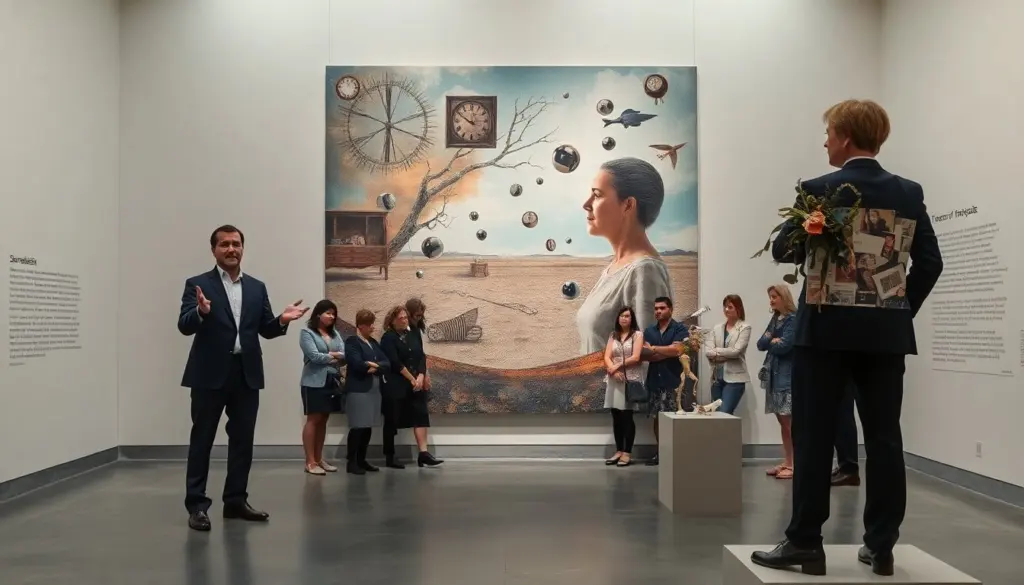
Surrealism meaning in art can be seen across a wide range of media and in the work of artists who each translated the movement’s aims in distinctive ways. Salvador Dalí deployed meticulous pictorial surfaces and paranoiac-critical methods to render hallucinatory scenes—melting clocks and distorted figures—that fuse precise draftsmanship with dream logic. René Magritte used ordinary objects in unexpected contexts, pairing clear, flat lighting with visual puns to make familiar things feel mysterious and to question representation itself. Max Ernst explored collage, frottage (rubbing textures onto paper), and decalcomania to generate dense, tactile imagery that evoked spontaneous visions. Yves Tanguy created sparse, otherworldly landscapes populated by biomorphic shapes that float in eerie spatial fields.
Technique was not limited to painting. Sculptors such as Giacometti and Méret Oppenheim incorporated found objects and assemblage to create three-dimensional surreal encounters; photographers used staged tableaux, solarization, and darkroom manipulation to destabilize photographic evidence; printmakers exploited repeatable processes to introduce chance textures or repeated motifs. The surrealist periodical La Révolution surréaliste and other journals played a key role in disseminating methods and experiments—publishing automatic texts, photographic essays, and reports on collective happenings. Exhibitions were often theatrical and deliberately provocative, staging installations and performances that blurred art and life.
Surrealism meaning in art also extended into cinema, theater, fashion, and design. Filmmakers and theater directors borrowed surrealist strategies—nonlinear montage, dream sequences, and irrational juxtapositions—to challenge narrative continuity and spectator expectation. Fashion designers adapted surreal motifs, such as exaggerated silhouettes and unexpected material pairings, while advertising occasionally adopted surreal imagery to create memorable, uncanny associations. Over time, the movement’s visual and conceptual tools were absorbed into later avant-gardes and popular forms, ensuring that surrealism meaning in art remains a reference point for artists and creators who want to unsettle perception and make the unconscious visible.