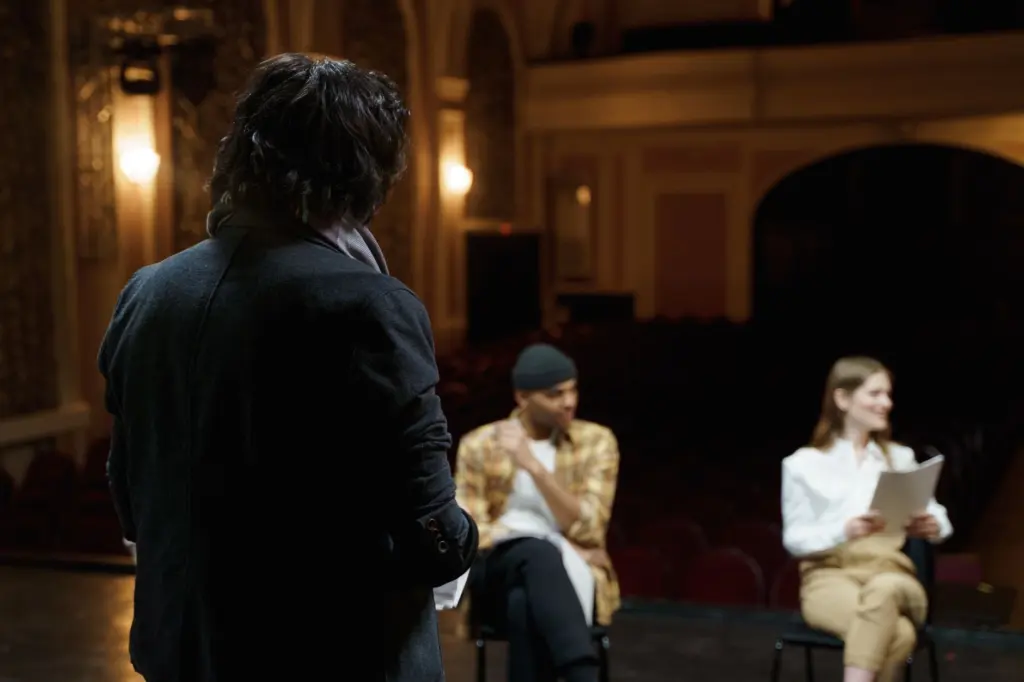
A director circles a line and asks whether the actor should say it aloud. No. Stage directions in a script are written for the creative team, not spoken, and they work best as brief suggestions placed before the action they describe.
The same habits apply whether you are drafting a first play or preparing a cast, and they sit inside the larger job of how to produce a community theater show.
What stage directions are and what they are not
Stage directions are written by the playwright to inform readers and the creative team about the time period, set considerations, production requirements, stage action and movement. They cover character movement, entrances and exits, and interpretation of lines, including style and tone. A drama formatting guide adds that they contain important information for understanding the plot and dialogue, so a reader who skips them can lose the thread.
Most mistakes come from treating directions as something they are not. The table sets the common assumptions against what the guidance supports.
| Common assumption | What is supported | Planning use |
|---|---|---|
| Directions are lines the actor speaks | They are guidance for the creative team and are not written to be spoken aloud | Keep them visibly apart from dialogue so no one reads them out |
| Directions are binding orders | They are suggestions for the artistic team | Write what the scene needs and leave room for the director’s choices |
| Film-style description works on stage | Stage directions direct the actors, not the camera | Describe what a performer does, not what a lens sees |
| There is one official format | Publishing houses have their own policies and no uniform rules exist | Follow the policy of the publisher or programme you are submitting to |
| More detail is safer | Directions should be terse, with options discussed in production notes | Cut anything the scene does not need |
The first four rows draw on Breaking Character’s guide to stage directions, and the camera and brevity points come from a playwright’s tips for writing stage directions.
Formatting stage directions in a script
Stage directions are usually formatted differently from dialogue, typically in italics and often in parentheses. Another guide says they are usually italicized or set apart from the dialogue and kept brief. Pick one convention and apply it throughout, because the visual separation is what tells an actor not to speak the text.
Scene headings and opening directions
A stage play heading identifies the setting in plain language, and the aim is clarity, not cinematic precision. A heading might read DRAWING ROOM. EVENING. After it, a short scene-setting direction is good practice. Examples from the guides:
- Brief setting line: A country road. A Tree. Evening. gives place, one key object and time of day.
- Lights-up opening: Lights up on a messy living room. Late afternoon. places the audience’s first view in a single sentence.
The first example comes from the tips for writing stage directions, the second from a stage play script guide.
Scene numbers and technical cues
Scene numbering can be placed before or after the scene, written as Scene 1 or (Scene 1), according to this formatting guide. The same guide notes that technical instructions for sound, lighting or music can be integrated into the script. Include them when a cue changes how a moment plays. Leave them out when the technical team will decide independently.

How much detail to include
Include only what a director or actor needs to act on. The guidance favours terse directions: if you want to discuss options, do so in production notes rather than in the script itself. The same source also says directors and actors need to know the features of their environment, so describe the set only where it affects what follows.
- Cut decorative specifics. Write that a character picks up a newspaper rather than naming the paper, unless the name matters to the scene.
- Put the direction before the action. It is better to tell the actor before the action happens than to explain it afterwards.
- Keep entrances and exits. Shakespeare’s directions are almost completely limited to entrances and exits, which shows how much a play can carry on very little.
- Leave room to interpret. Directors and actors often want and need the freedom to interpret things, so avoid dictating emotions line by line.
A useful test is whether a direction changes what the audience sees or what the actor can do. If it only restates the dialogue or labels a feeling the line already carries, delete it. If it supplies information the dialogue cannot, such as a movement that changes the meaning of a line, keep it.
Stage terminology for directions
Use the standard stage vocabulary so every reader interprets a direction the same way. The advice is to use Upstage and Downstage, Stage Left and Stage Right.
- Upstage and downstage: the depth terms, used for where a character stands or moves along the stage.
- Stage left and stage right: the side terms, used for entrances, exits and crosses.
- Abbreviations: avoid forms such as DSL for less experienced actors and write Downstage Left in full.
Spelling terms out costs a few characters and saves a rehearsal question. Abbreviations suit a stage manager’s own prompt copy, but a script that goes to a mixed cast is better without them.
Working with directors and actors
Directions that touch movement, entrances and exits overlap with blocking, and this is where the playwright’s text meets the director’s choices. Because the directions are suggestions for the artistic team, the director can keep, change or drop them. It is best if directors and playwrights collaborate on editing the stage directions, ideally before rehearsal begins, so the cast works from one agreed text.
- Playwrights: write directions an actor can use at once, and expect some to change in rehearsal.
- Directors: keep a direction when it serves the scene, and ask the playwright before cutting one that carries plot information.
- Actors: treat directions as starting points, since stage directions are not spoken text and remain open to the director’s choice.
Related reading for performers
Performers preparing for auditions can pair this guide with Best Audition Songs For Altos In 2026: Top Picks, Keys, And Prep Tips for musical choices. Younger performers working on short pieces can look at Short Monologues For Kids: Easy, Funny, And Dramatic Pieces For Class Or Auditions (2026 Edition), where brief, clear text matters just as much.
Frequently asked questions
| Question | Answer |
|---|---|
| Are stage directions spoken aloud in performance? | No. They offer guidance to the creative team and are not written to be spoken aloud. |
| Should I write DSL or Downstage Left? | Write Downstage Left in full when less experienced actors will read the script, as the tips for writing stage directions advise. |
| Is there one required format? | No. Publishing houses have their own policies and no uniform rules exist, so check the policy of the publisher you are targeting. Italics or parentheses are the usual choices. |
| Can I put sound and lighting cues in the script? | Yes. Technical instructions regarding sound, lighting or music can be integrated into the script, though they are optional. |