The phrase famous abstract painting appears here to signal the article focus. The guide names key works and explains their impact. It shows why these paintings matter in art history and museum displays. The text remains clear and direct. It helps readers spot important works and understand why critics and collectors value them. Below we expand on the factors that make an abstract work notable, review early pioneers and specific breakthrough works, examine four iconic paintings in more depth, and offer practical guidance for appreciating and displaying a famous abstract painting today.
Key Takeaways
- A famous abstract painting gains recognition through formal innovation, cultural impact, and ongoing scholarly and public engagement.
- Early pioneers like Kandinsky, Malevich, and Mondrian shaped the abstract art movement by focusing on color, geometry, and balance without literal representation.
- Wassily Kandinsky’s Composition VII is celebrated for merging color and emotion, influencing future abstract expressionists.
- Kazimir Malevich’s Black Square challenged traditional art by reducing painting to pure form, impacting minimalism and art criticism.
- Piet Mondrian’s Composition With Red, Blue And Yellow demonstrates how structure and primary colors create visual harmony and have inspired design across media.
- To fully appreciate famous abstract paintings today, viewers should engage with context, and collectors must ensure proper display conditions to preserve these works.
What Makes An Abstract Painting “Famous”?
A famous abstract painting gains fame for several clear reasons. A work shows formal innovation that changes how artists use color, line, or space. A painting ties to a cultural moment and sparks public debate. Museums and critics publish research that raises a painting’s profile. Collectors buy and lend a painting for major exhibitions. Education and reproduction put the image in books and online. Together, these factors create a steady public record that keeps a painting visible over decades.
Beyond those core drivers, fame also depends on provenance and exhibition history: who owned the painting, the galleries and museums that have shown it, and whether it appeared in influential retrospectives or survey shows. Scholarly attention—catalogues raisonné, journal articles, and teaching syllabi—helps embed a work in the canon. Popular exposure, such as reproductions in textbooks, magazine covers, or inclusion in televised documentaries, widens recognition to non-specialist audiences. Market attention (high-profile sales or record-setting auction results) can heighten interest, but lasting fame usually rests on demonstrable influence within art practice and discourse rather than price alone.
Early Pioneers And Their Breakthrough Works
Early pioneers made abstract art into a major movement. They rejected literal depiction and focused on visual elements. Wassily Kandinsky experimented with color and musical analogy in the 1910s. Kazimir Malevich introduced geometric reduction and radical simplicity in the 1910s and 1920s. Piet Mondrian refined a grid and primary palette in the 1920s. Critics and galleries responded with essays and shows. These responses helped the works become reference points for later artists and curators.
These artists developed different strategies that expanded what painting could do. Kandinsky explored synesthesia and spiritual resonance through dynamic compositions; his experiments showed that abstraction could be a language for inner states. Malevich’s reduction to basic shapes argued for painting as an autonomous activity, not a window on the world. Mondrian’s pursuit of equilibrium and purity of line proposed a new kind of universal order. Each approach gave later artists models to accept, reject, or reinterpret, producing a lineage of experimentation that includes geometric abstraction, lyrical abstraction, minimalism, and abstract expressionism.
Four Iconic Abstract Paintings And Why They Matter
This section lists key paintings. Each entry states what the painting changed and why viewers should notice composition, color, or intent.
Wassily Kandinsky — Composition VII
Kandinsky painted Composition VII in 1913. The work layers color, line, and gesture to suggest emotion. Critics call it a turning point in abstract painting history. The painting shows how abstract forms can pursue spiritual expression. Museums place the work in surveys of early modernism. Students study it for its dense visual rhythm and scale. The painting influences later abstract expressionists and color-field painters.
When viewing a work like Composition VII, note the interplay between controlled structure and frenetic mark-making. Look for how color combinations create local contrasts and overall harmony, and how areas of dense activity sit next to quieter spaces. Consider also the historical moment: the painting predates major political shifts in Europe and reflects a search for new modes of expression that break with representational conventions.
Kazimir Malevich — Black Square
Malevich painted Black Square in 1915. The work reduces painting to a black geometric form on a white field. It challenges the idea that painting must represent real objects. Critics used the image to argue that art can exist as pure form. The painting appears in key museum collections and in scholarly debates. It shaped later minimal art and the way curators write wall texts about abstraction.
Black Square’s significance lies in its conceptual provocation as much as its visual austerity. It forced viewers and institutions to ask: what is painting without subject? Its starkness became a tool for theoretical discourse about the limits of representation, the role of the canvas as object, and the ceremony of display. In galleries, the work is often shown with clear sightlines and precise lighting to emphasize its flatness and material presence.
Piet Mondrian — Composition With Red, Blue And Yellow
Mondrian completed this work in the 1920s. The painting uses a grid and primary colors to express balance. Mondrian removed natural detail to focus on structure and proportion. Critics and designers adopted his visual language across media. The work appears in design histories and museum catalogs. Viewers use it as a clear example of how reduction and order can create visual power.
Mondrian’s paintings are useful case studies in how abstraction can translate into other fields: architecture, graphic design, fashion, and product design have all borrowed his vocabulary of grid and color. When examining this painting, pay attention to the rhythm of vertical and horizontal lines and how the limited palette directs the eye. Consider the painting’s legacy in both fine art pedagogy and everyday visual culture.
How To Appreciate And Display Famous Abstract Paintings Today
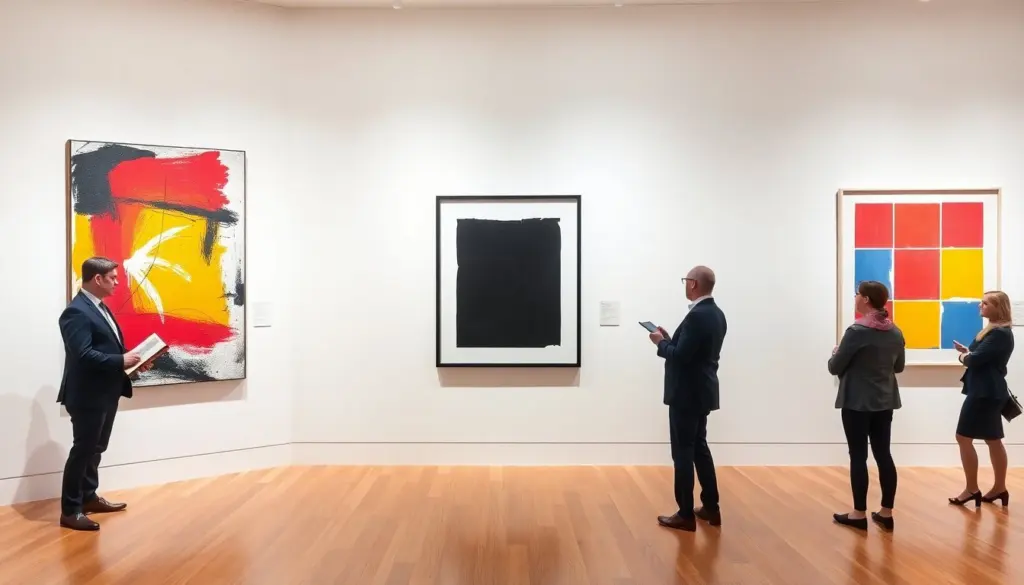
A viewer should take time to look and then to read context. Museums supply labels that state date, materials, and artist intent. Galleries place works with breathing room so viewers can see scale and detail. A collector should consider light, humidity, and framing when hanging an important work. A museum team tests light levels and mounts works on stable backing. Educators pair images with short texts that explain form and history. Reproduction for study should use high-quality images that preserve color and scale.
Here are practical steps for deeper appreciation and responsible display:
– For visitors: begin with visual observation—note composition, dominant colors, and any recurring shapes—then read the label and related wall texts. Spend uninterrupted time with the painting, moving closer to inspect surface texture and stepping back to assess overall balance.
– For educators: contextualize the painting within movements, show comparative images of related works, and encourage questions about intent and technique. Use guided prompts that ask viewers to describe emotional responses and to identify formal elements that produce them.
– For collectors and curators: maintain stable temperature and relative humidity, control light exposure (especially UV), use museum-grade framing and mounting materials, and consult conservators before any cleaning or restoration. Consider exhibition context carefully: a famous abstract painting often benefits from neutral surroundings that do not compete with its visual language.
Finally, engagement is ongoing: new scholarship, conservation findings, and exhibition strategies continually reshape how we understand famous abstract painting. Whether you encounter these works in a major museum, a traveling show, or a classroom reproduction, combining careful looking with contextual reading will reveal why certain abstract paintings have become enduring touchstones in modern art.